AI Search Is Already Taking Your Customers Away. Is Your SaaS Product Visible in ChatGPT and Perplexity Responses?
Vertical SaaS and Horizontal SaaS Trends That Eat Up Your Income
The SaaS industry is entering one of the most disruptive phases in its history. For years, product companies fought for visibility in Google search results, investing in SEO, content, and digital marketing to fill their sales pipelines. But today, your potential customers may never reach your website at all.
Why? Because AI search engines like ChatGPT, Perplexity, Gemini, Claude, Grok, and Google’s AI Overviews are giving answers directly to users — without a single click to your site.
This shift is not a distant trend. It’s already happening. And for SaaS CEOs, founders, and owners, the risks are very real:
- Lost ARR growth because buyers no longer find you when entering new markets.
- Missed sales opportunities for SaaS as AI assistants recommend competitors.
- Rising CAC since you’re forced to compensate with paid channels.
- Declining LTV and retention if your brand loses visibility in comparison lists and “best SaaS” queries.
Put simply: AI search is quietly taking your customers away.
Why AI in SaaS Is a Critical Threat
Until recently, being in the top 3 Google results meant steady traffic, leads, and revenue growth. Now, with Google AI Overviews and platforms like ChatGPT or Perplexity AI, things have changed:
- Zero-Click Search
Users ask a question, and AI engines generate an instant answer. Often, it contains everything the buyer needs. No clicks, no visits to your website = less traffic, fewer leads from organic channels. - Shift in Buying Journeys
In B2B SaaS, decision-makers increasingly rely on Generative AI to research software by asking “What SaaS CRM integrates with Slack and Zoom?” or “Best AI tools for customer success”. If your product isn’t mentioned, you’re invisible during the evaluation stage. - Competitive Disadvantage in New Markets
Expanding into the US, Canadian, or EU SaaS markets without AI visibility means you can’t compete with local players who already appear in ChatGPT or Gemini responses. Your TAM share is reduced not because of your offering, but because of poor visibility in AI search.
If you’re asking yourself “Why is my organic traffic down?”, chances are it’s because AI engines have replaced traditional search behaviors.
Clear Evidence: AI Search Is Stealing SaaS Traffic
Here’s a simple test: ask ChatGPT or Perplexity “What are the best SaaS project management tools in 2025?” You’ll see Monday, Asana, ClickUp, or Notion – but not your brand.
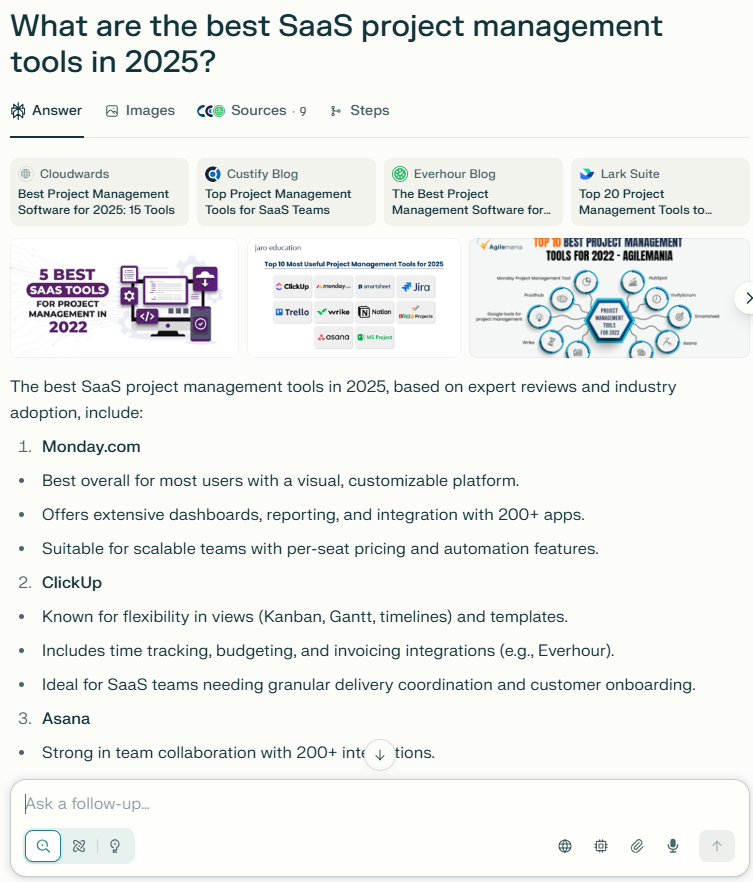
That’s not a glitch. It’s how Large Language Models (LLMs) work: they select well-structured, authoritative sources, summarize them, and cite only a few.
Current SaaS landscape: Only a handful of SaaS companies get recommended. The rest lose visibility, clicks, and revenue.
What This Means for Your Business Metrics
Here are some of the real costs when your SaaS product is left out of AI-search answers:
| Metric | What happens when visibility drops | Example / Impact |
| ARR (Annual Recurring Revenue) | Fewer leads → fewer deals closed → less recurring revenue | If your SaaS targets $1M ARR benchmarks via organic leads, but lose 30% qualified leads because of AI zero-click loss, that’s $300K ARR shortfall |
| CAC (Customer Acquisition Cost) | You pay more in paid channels to compensate for lost organic/AI query referrals | Suppose your CAC was $500 per customer when organic leads were strong. With loss of AI visibility, you may need paid ads costing $1,000+ to get similar volumes |
| Sales Pipeline | Weak pipeline because fewer prospects discover you during the awareness / evaluation stage | Lower demo requests, fewer trial signups, smaller lead generation volume and conversion rate |
| Market Share / Total Addressable Market (TAM) | Competitors who manage to appear in AI answers grab your potential customers first | When entering a new country (e.g. Germany, Canada), being omitted from AI-based summaries or comparison lists means you’re not considered |
This is no longer just a SEO issue – it’s a business growth risk in a new reality and new SaaS industry trends.
Case in Point: Stop Losing Traffic to AI Search
One of Upcorn’s SaaS clients saw (as many other AI SaaS companies) a sharp decline in organic traffic right after Google’s AI Overviews launched in their target region.
Problem:
| Fewer leads ↓ | → | weaker pipeline ↓ | → | loss of revenue ↓ |
Solution: To Implement an AI-first SEO strategy combining classic SEO with Generative Engine Optimization (GEO).
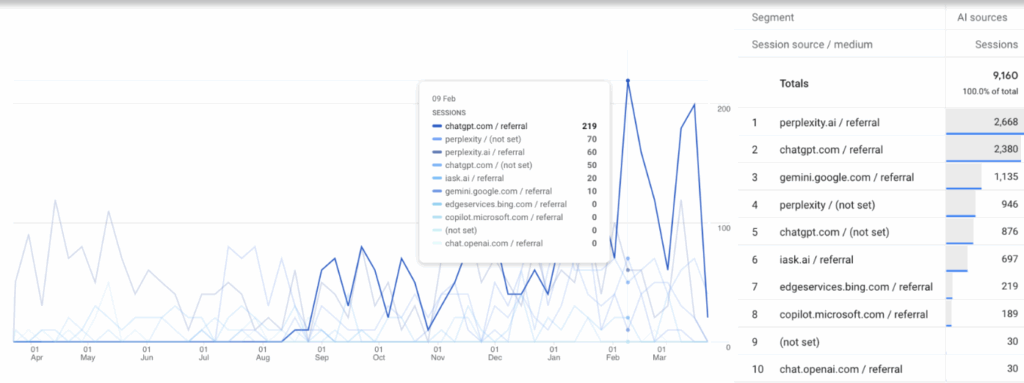
Results: Within six months, the brand was cited in answers of all AI chatbots – ChatGPT, Perplexity, Gemini, Copilot, etc., and got:
500 clicks
per day from AI Search
3200%
growth in AI Search traffic
Read the full case study here
Success Formula for SaaS Companies: SEO + GEO
The future belongs to companies that master a comprehensive SEO strategy for SaaS leveraging both traditional search visibility and AI search optimization (in other words, generative engine optimization). This isn’t about choosing between SEO and AI visibility – it’s about ensuring your SaaS product appears in AI search results, not just in Google’s top 10.
Core AI Visibility Strategies:
1. Technical AI Optimization
- Implement schema (structured data) to help LLMs recognize your brand
- Make on-page optimization by adding titles, headings, meta description (they still matter)
- Set up AI analytics to track citations and response appearances
2. Strategic Content Marketing & Link Building
Focus on content that AI engines prioritize:
- Clear, structured content with proper H1-H3 hierarchy
- FAQ sections that directly address user queries and search intent
- Expert insights and mentions in respected SaaS industry media, including comparison overviews, rankings, and “Best/Top/Leading” listicles.
- High-quality backlinks from authoritative sources.
3. Topical Authority Building for AI Recognition
Strengthen your E-E-A-T signals (Experience, Expertise, Authority, Trustworthiness):
- Industry thought leadership content
- Promotion on Reddit as one of the proven strategies to secure brand mentions in AI responses.
- Digital marketing for SaaS (like LinkedIn, Facebook, Instagram to be tuned with B2B SaaS trends).
- Being active in niche communities and industry-specific forums (like Quora, GitHub, etc.).
- Customer success stories
- Technical integration guides that AI engines reference
How To Execute: In-House Team vs Outsource vs Hybrid
| Approach | Pros | Cons |
| In-house team | Deep product knowledge; control over content; long-term investment | Learning curve; slower to test & iterate; can be costly if lacking AI/SEO experience |
| Outsourced agency with SaaS & AI expertise | Faster deployment; access to methodologies already tested (like Upcorn’s); potentially more cost-efficient; immediate traction | Need some oversight; risk of miscommunication if product knowledge isn’t transferred well |
| Separate cross-functional team (SEO + product + marketing) | Focused resource; faster integration; better feedback loops | Requires a lot of coordination; may duplicate some internal roles; cost overhead |
Key Takeaways for SaaS Executives
- AI search is already changing customer acquisition – ignoring it means higher CAC, shrinking market share, and lost SaaS growth opportunities.
- SEO for SaaS is no longer enough. You need a Generative Engine Optimization strategy to appear in ChatGPT, Perplexity, Gemini, and Claude answers.
- AI visibility is now a must-have for all SaaS and product companies entering or protecting markets in any part of the world.
Next Step: Free AI SEO Audit
Want to know exactly how much visibility (and how many leads) AI search has already cost your SaaS? Let’s find out.
👉 Book a free AI Visibility & SEO Audit with a customer acquisition agency trusted by leading SaaS companies worldwide. We’ll identify your gaps right now and tell what customer acquisition tools will better fit your unique business models and needs.
The Future of SaaS Is Now. Don’t Get Left Behind.